
Commissioning · Certification
By Jeff Kiser, Founder — KOR Systems
On a construction project, the word ‘done’ is used a lot. The electrical is done. The HVAC is done. The cabling is done. But done means different things for different scopes, and for structured cabling, done has a specific technical meaning: every installed cable run has been tested by a calibrated field tester, the results have been measured against the applicable channel performance standard, and a pass result has been recorded and documented.
Without that step, the cabling is installed — but not certified. And uncertified cabling is, from an owner’s perspective, cabling of unknown quality. You do not know if it will support the performance the network equipment expects. You do not know if the terminations are within tolerance. You do not know if the bend radii were respected during installation. You have cable in the wall and hope.
This guide covers what structured cabling certification actually involves, what the documentation should look like, why it matters for certificate of occupancy, and what it tells you about the quality of the contractor you hired. For the bigger picture on why this infrastructure deserves that scrutiny, see our related guide on the part of your network that will outlast everything else.
What Certification Testing Measures — and Why It Cannot Be Skipped
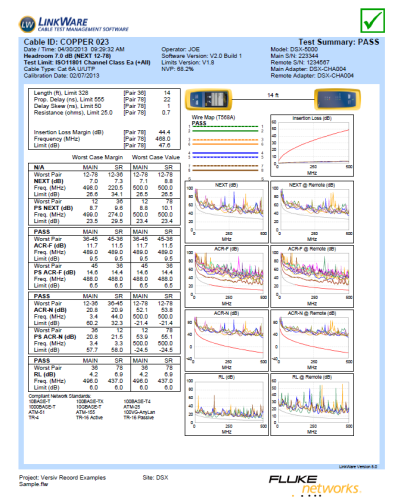
Structured cabling certification testing uses a calibrated field tester — Fluke Networks DSX series, for example — to measure the electrical performance of every installed cable run against the TIA-568 channel performance standard for the specified cable category. For Cat6A, that means measuring insertion loss, return loss, NEXT (near-end crosstalk), ELFEXT (equal-level far-end crosstalk), propagation delay, and delay skew across the full frequency range the standard requires.
Each measurement has a pass/fail threshold defined by the standard. A run that fails any one of those parameters has a problem: a damaged cable, an improperly terminated connector, excessive pulling tension during installation, a bend radius violation, or a run that exceeds the 295-foot maximum channel length. The test tells you which parameter failed and often points toward the cause.
The reason certification cannot be skipped is that visual inspection does not find these problems. A cable that looks fine can have a performance issue introduced at termination that is invisible to the eye and fatal to 10-gigabit transmission. The field tester finds what the eye cannot.
What the Certification Documentation Should Contain
A complete certification documentation package is a structured record of every test result for every cable run in the project. It is not a summary. It is not a percentage pass rate. It is a per-run record that identifies each cable by its permanent link ID, records the test result, captures the measured values for each performance parameter, and timestamps the test with the tester’s calibration date.
At minimum, the documentation package should include:
- A test result for every installed run — typically in the tester’s native report format (Fluke LinkWare, for example), exported as both the native .flw file and a PDF summary
- Pass/fail status for each run against the applicable channel standard (TIA-568-C.2 for Cat6, TIA-568-C.2-1 for Cat6A)
- Cable ID and panel port reference for each tested run, matching the as-built labeling in the field
- Tester model, serial number, and current calibration date — calibration is typically annual, and out-of-calibration results are not valid
- Any failed runs with documentation of the corrective action taken and the re-test result
A contractor who cannot deliver this documentation package has not certified the installation. Receiving a spreadsheet summary or a single aggregate report is not the same thing as receiving per-run test results.
Certification, CO, and the Inspection Sequence
In most jurisdictions, the low-voltage rough-in is inspected by the authority having jurisdiction (AHJ) — typically the local building department or a designated third-party inspector — as part of the construction inspection sequence. The rough-in inspection covers the physical installation: conduit fill, cable support, fire-stop penetrations, equipment grounding, and compliance with the approved drawings.
Certification testing happens after the rough-in inspection, because it tests the completed channel — from outlet to patch panel — which requires the terminations to be finished. In the certificate of occupancy sequence, the AHJ typically requires confirmation that the low-voltage systems are complete and functional before issuing the CO. A certification documentation package satisfies that requirement for the structured cabling scope.
Where projects get into trouble is when the testing sequence is compressed or skipped. A GC facing a CO deadline may pressure the low-voltage contractor to sign off before testing is complete. That creates a documented conflict: the project record says the cabling is certified, but the certification documentation does not exist. If a problem surfaces after occupancy, the liability question becomes complicated.
The cleaner approach is to treat certification documentation as a deliverable, specified in the contract with a delivery date tied to substantial completion. That gives the low-voltage contractor a clear obligation and gives the owner a clear expectation.
| Inspection Stage | What Gets Checked | Who Performs It |
|---|---|---|
| Low-Voltage Rough-In | Conduit fill, cable support, fire-stop, grounding, drawing compliance | AHJ / building inspector |
| Certification Testing | Per-run electrical performance against TIA-568 channel standard | Low-voltage contractor (calibrated tester) |
| Documentation Delivery | Complete per-run test results, as-builts, labeling record | Low-voltage contractor |
| CO Confirmation | Confirmation that low-voltage systems are complete and documented | AHJ / owner’s representative |
What Certification Tells You About the Contractor
A low-voltage contractor who delivers a complete certification package — per-run results, calibrated tester documentation, matched as-built labeling — is a contractor who is accountable for the quality of the installation. The certification results are the evidence.
A contractor who resists delivering full certification documentation, who provides summary reports instead of per-run results, or who cannot identify the calibration date of the tester used on the project is telling you something. The test data either does not exist or does not pass. Neither outcome is acceptable for permanent building infrastructure.
In our experience, the contractors who commission and certify correctly are also the contractors who install correctly. The two are not independent. A team that takes termination quality seriously enough to test every run is a team that took installation quality seriously enough to get clean results. Working with a BICSI-certified low-voltage contractor whose quality-assurance process treats certification as a deliverable is the most reliable way to get that result. Certification is the proof, but the habit it reflects starts at the pull.
Specifying Certification in the Contract
The most effective protection for owners and developers is to specify certification requirements in the low-voltage scope of work, not to assume they are included. The contract language that matters includes: reference to TIA-568 as the applicable standard; requirement for field testing of 100% of installed runs (not a sample); requirement for calibrated tester documentation; delivery of per-run test results in the tester’s native format; and delivery of as-built documentation that matches the installed labeling.
It is also worth specifying a warranty period and requiring the contractor to maintain calibration records. A structured cabling system warranted against workmanship defects — with the certification results as the baseline — gives the owner recourse if performance problems emerge after occupancy.
When evaluating contractors, ask for a sample documentation package from a comparable completed project. A qualified contractor will have these readily available. A contractor who cannot produce them is not doing the work the way it should be done.